
NIRS-IVUS Imaging
NIRS-IVUS Imaging in Tirunelveli & Thoothukudi
Look Beyond the Blockage. Understand What’s Inside Your Arteries.
Coronary artery disease is not just about narrowing of the arteries. Understanding the composition and structure of coronary plaques can also be important in evaluating heart disease.
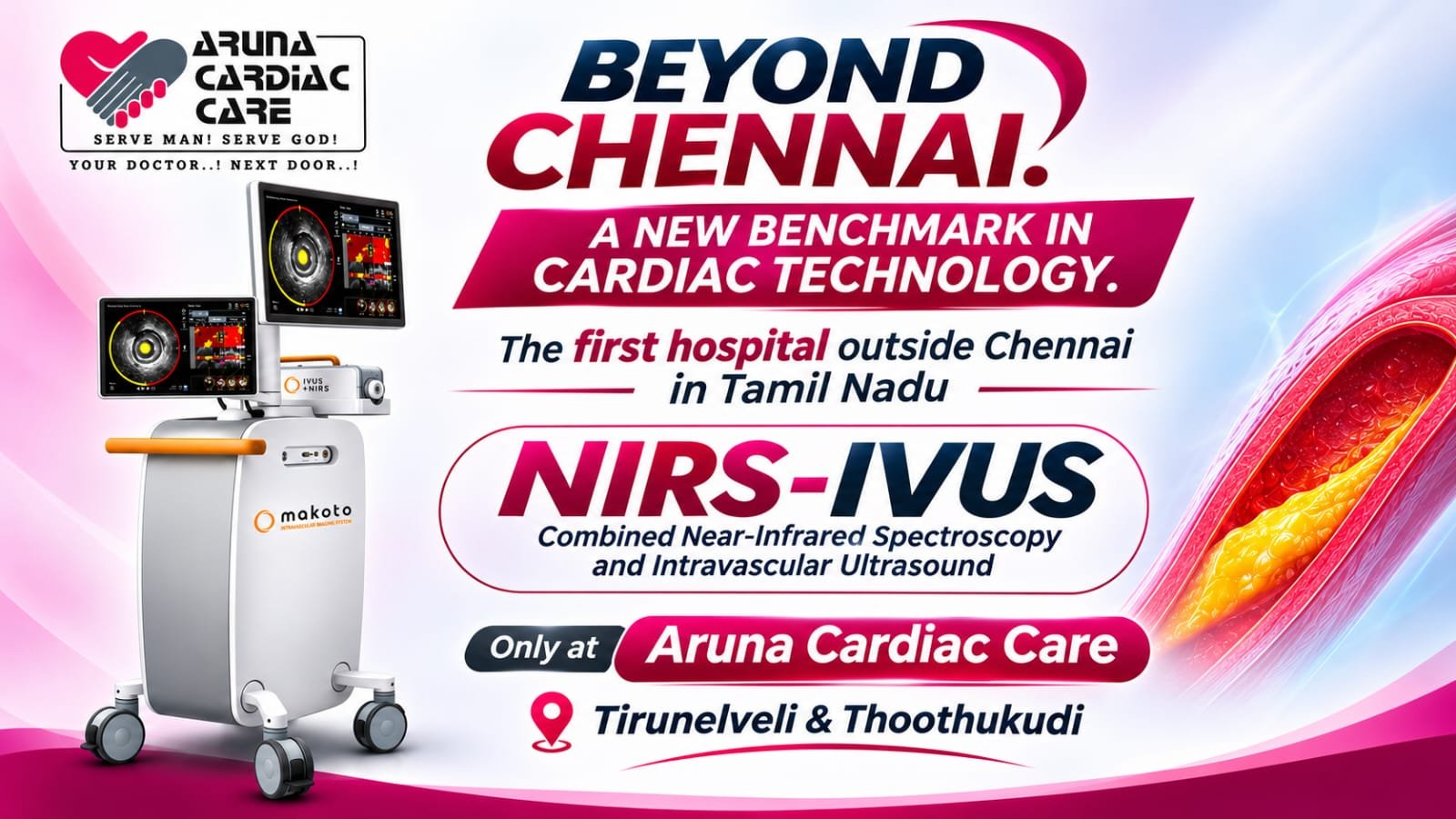
At Aruna Cardiac Care, we offer advanced NIRS-IVUS coronary imaging to help cardiologists assess coronary artery plaque composition, vessel structure and plaque burden.
This combined imaging technology provides detailed information that conventional coronary angiography alone may not reveal.
What Is NIRS-IVUS?
NIRS-IVUS stands for Near-Infrared Spectroscopy and Intravascular Ultrasound.
It is an advanced intracoronary imaging technology that combines two complementary techniques in a single catheter.
1. Near-Infrared Spectroscopy (NIRS)
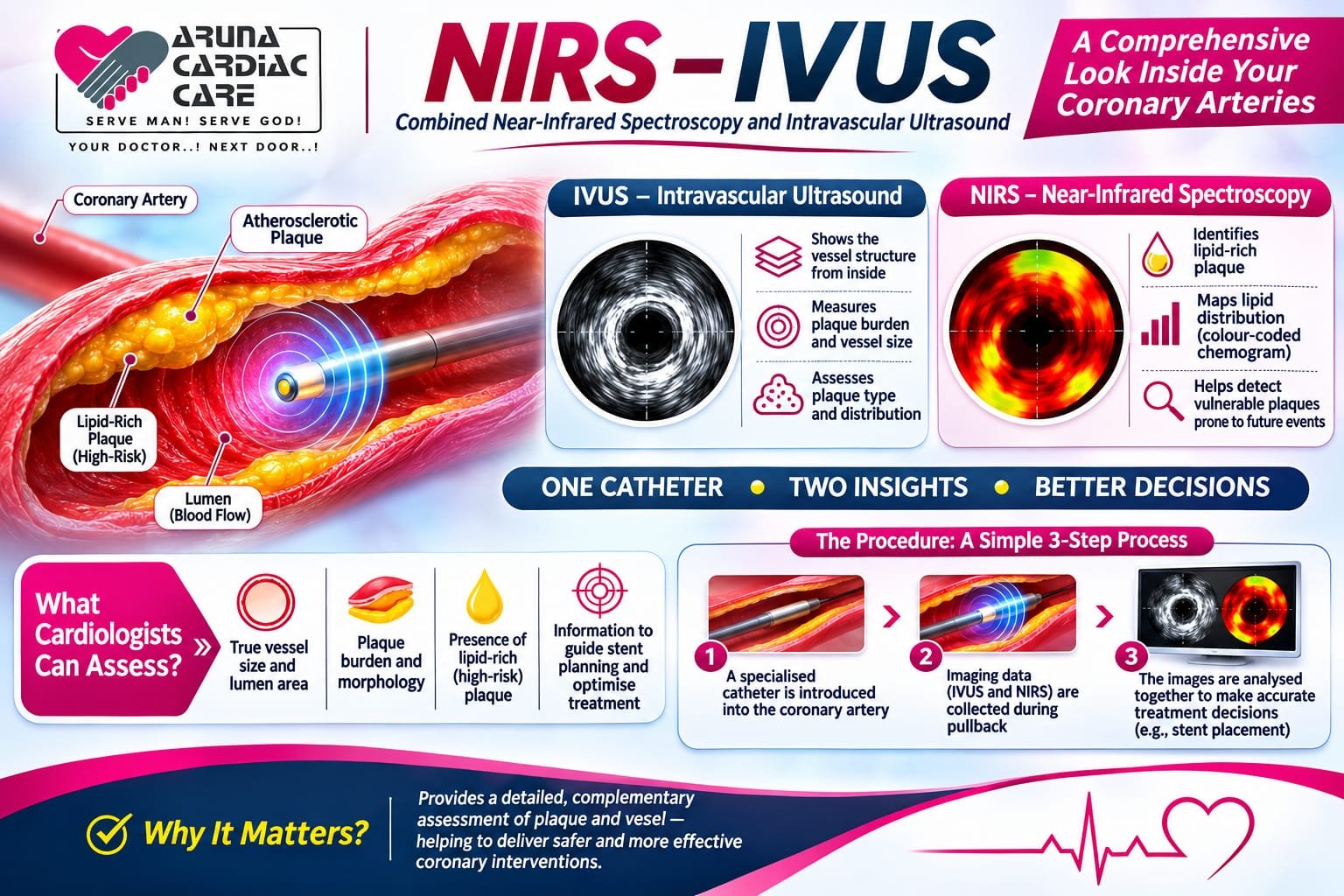
NIRS analyses the chemical characteristics of coronary artery plaques and helps identify lipid-rich plaques, which contain a significant amount of cholesterol and other lipids.
2. Intravascular Ultrasound (IVUS)
IVUS uses ultrasound waves from inside the coronary artery to create images of the vessel wall, lumen and plaque structure.
Together, NIRS and IVUS provide complementary information about coronary plaque composition and vessel anatomy.
Why Is NIRS-IVUS Important?
Traditional coronary angiography primarily shows the inside outline of coronary arteries and helps identify areas of narrowing.
However, it may not provide complete information about plaque composition and the underlying vessel structure.
NIRS-IVUS provides additional information by helping cardiologists:
-
Identify lipid-rich coronary plaques.
-
Assess coronary artery plaque burden.
-
Examine vessel dimensions and structure.
-
Evaluate plaque characteristics.
-
Support coronary intervention planning.
-
Assess the treated coronary segment during selected procedures.
What Conditions Can NIRS-IVUS Help Evaluate?
NIRS-IVUS may be used as part of the evaluation and treatment planning for:
-
Coronary artery disease.
-
Lipid-rich coronary plaques.
-
Complex coronary artery lesions.
-
Selected high-risk plaque characteristics.
-
Coronary lesions requiring detailed imaging before angioplasty.
-
Selected cases requiring assessment after stent implantation.
The decision to perform NIRS-IVUS depends on the patient’s clinical condition and the cardiologist’s assessment.
How Does NIRS-IVUS Work?
NIRS-IVUS is performed during a coronary catheter-based procedure.
Step 1: Catheter Introduction
A specialised imaging catheter is guided into the coronary artery through a catheter-based access route.
Step 2: IVUS Imaging
Ultrasound technology captures detailed images of the coronary artery lumen, vessel wall and plaque structure.
Step 3: NIRS Analysis
Near-infrared spectroscopy analyses the plaque’s lipid content and generates a colour-coded map called a chemogram.
Step 4: Combined Assessment
The cardiologist reviews both imaging outputs to understand the plaque composition and coronary artery structure.
Step 5: Treatment Planning
The findings may help guide decisions during selected coronary interventions.
NIRS-IVUS vs Conventional Angiography
| Conventional Angiography | NIRS-IVUS |
|---|---|
| Shows the coronary artery lumen | Images the vessel from inside |
| Identifies areas of narrowing | Assesses vessel structure and plaque burden |
| Limited information about plaque composition | NIRS identifies lipid-rich plaque |
| Provides a two-dimensional angiographic view | Provides complementary intravascular imaging information |
Benefits of NIRS-IVUS
-
Detailed coronary artery assessment.
-
Identification of lipid-rich plaques.
-
Better understanding of plaque composition.
-
Assessment of vessel dimensions.
-
Additional information for complex angioplasty planning.
-
Complementary imaging during selected coronary interventions.
NIRS-IVUS is an additional diagnostic tool and does not replace clinical evaluation or other cardiac investigations.
Why Choose Aruna Cardiac Care?
-
-
Advanced coronary diagnostic facilities.
-
Specialised interventional cardiac care.
-
Detailed coronary artery evaluation.
-
Modern imaging-assisted cardiac procedures.
-
Individualised treatment planning.
-
Dedicated cardiac care services in South Tamil Nadu.
-
Contact Us
For more information or to schedule an angiogram, please contact us at +91 9487 66 55 77 . Our team is here to provide you with the highest level of care and support.
Frequently Asked Questions About NIRS-IVUS
1. What does NIRS-IVUS stand for?
NIRS-IVUS stands for Near-Infrared Spectroscopy and Intravascular Ultrasound. It combines two imaging technologies to assess coronary plaque composition and vessel structure.
2. What is the difference between NIRS and IVUS?
NIRS identifies lipid-rich plaque using near-infrared light analysis, while IVUS uses ultrasound to examine the coronary artery lumen, vessel wall and plaque structure.
3. Can NIRS-IVUS detect cholesterol plaques?
NIRS can identify and quantify lipid-rich plaque within coronary arteries, providing additional information about plaque composition.
4. Is NIRS-IVUS better than angiography?
They provide different types of information. Angiography shows the coronary artery lumen, while NIRS-IVUS adds information about plaque composition and vessel structure. They can complement each other.
5. Is NIRS-IVUS required for every angioplasty patient?
No. It is a specialised imaging technique used in selected patients when the treating cardiologist considers additional intracoronary information helpful.
6. Does NIRS-IVUS help during stent implantation?
IVUS can help guide stent sizing, placement and optimisation in selected coronary interventions. NIRS provides additional information about lipid-rich plaque.
Advanced Coronary Imaging at Aruna Cardiac Care
Understanding coronary artery disease requires more than just identifying blockages.
At Aruna Cardiac Care, we focus on advanced cardiac evaluation and personalised treatment planning.
Consult our cardiac specialists to understand whether NIRS-IVUS imaging is appropriate for your condition.
ARUNA CARDIAC CARE
Your Heart. Our Priority.
Tirunelveli | Thoothukudi
Contact us to book your cardiology consultation.